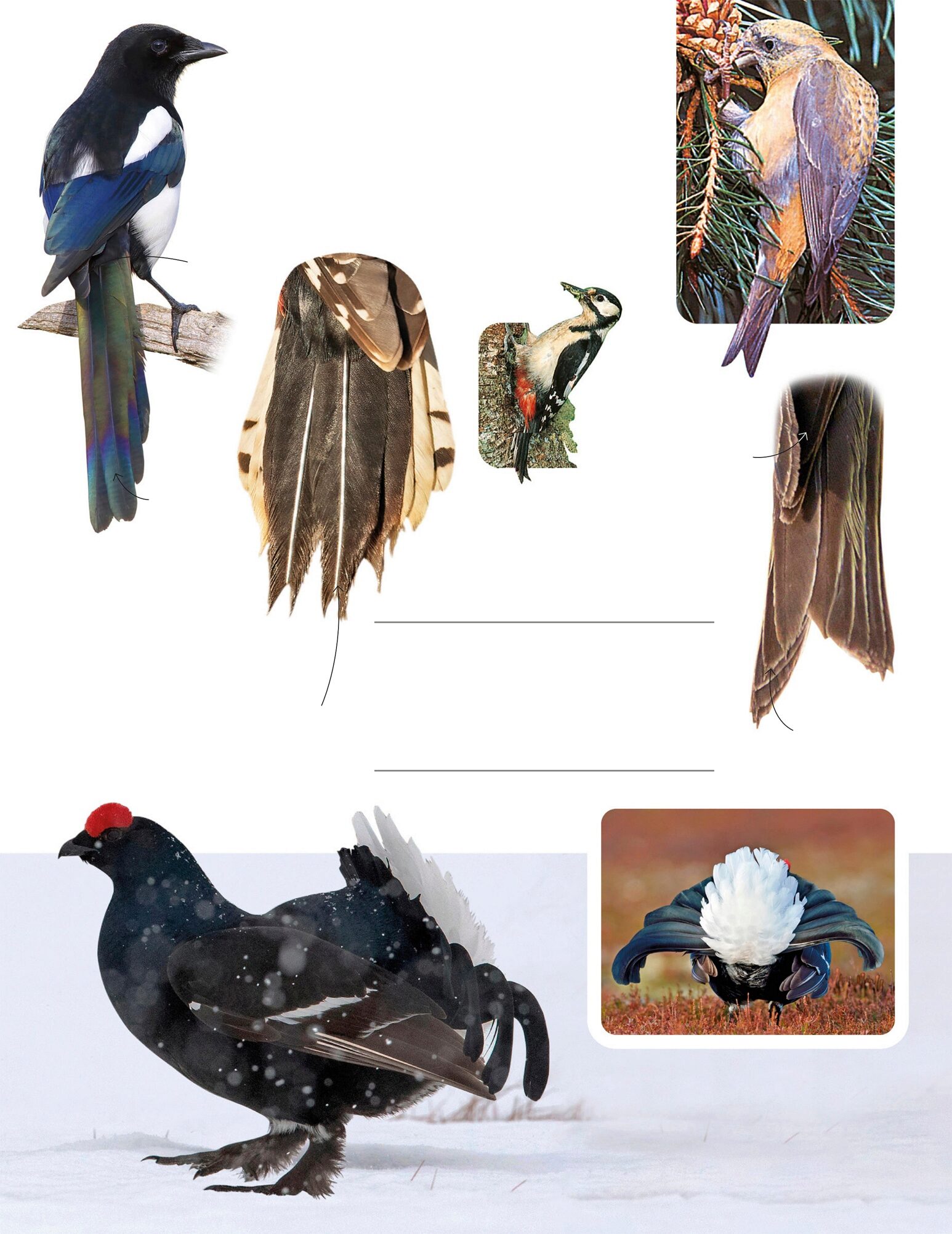
A tail for display
The male black grouse has crescent-shaped
tail feathers, while the female’s tail feathers
are straight. Differences like this are evidence
that the shape of the tail has evolved for
display rather than for fight.
Crossbill tail
Tail shapes
Birds that spend much of their time
airborne usually have light, streamlined
tails. Other birds, especially those that
live on the ground or in woodland, have
tails that are used for balance,
perching, or attracting a mate.
A tail for balance
The central feathers in a
magpie’s tail are nearly
25 cm (10 in) long. Long
tails are usually used for
display, but it is more likely
that in magpies they are
used for balance on the
ground or when
clambering in trees.
Forked tails
Many finches have
a fork-shaped tail
that helps them
manoeuvre. Juvenile
birds tend to have
more sharply
pointed tail tips
than adult birds.
Rump
feathers
Elongated
tail feathers
Fork-shaped
tail
Magpie
tail
Crossbill
Rump
feathers
Some
woodpeckers
can
hit a tree trunk
20 times
per second
.
Tails for support
A woodpecker uses its stiff tail for
support as it climbs a tree trunk. Its
tail feathers are unusually stiff so they can
support a large amount of the bird’s weight.
Great spotted
woodpecker tail
Great spotted
woodpecker
Sharp points
caused by
rubbing
against trees
Male black
grouse’s tail